Stone countertops have a way of making a kitchen or bath feel finished. They add weight, texture, and permanence. They also show wear in very specific ways, and that is where many homeowners get tripped up. A dull ring on marble is not the same problem as a chipped edge on granite. A hazy patch near the sink often points to a different fix than a darkened seam by the cooktop. If you want to restore countertops properly, the first step is knowing what kind of damage you are actually looking at.
I have seen beautiful marble countertops ruined by aggressive cleaners and granite countertops slowly lose their luster because someone thought sealer was polish. I have also seen the opposite: surfaces that looked ready for replacement come back with the right combination of cleaning, honing, polishing, filling, and protection. Good restoration is less about miracle products and more about matching the method to the stone, the finish, and the damage.
Marble and granite do not fail the same way
People often group natural stone together, but marble and granite behave differently under daily use. Marble is softer, more porous in practical terms, and more chemically reactive. It scratches easier, and acidic spills can etch the surface within minutes. Lemon juice, vinegar, wine, tomato sauce, and even some bathroom products can leave dull spots that look like stains but are actually changes in the surface texture.
Granite is harder and usually more resistant to scratching and etching. That said, granite is not indestructible. It can chip on corners, crack from impact or poor support, and lose its shine from abrasion or residue buildup. Some darker granites hide wear well, while lighter or highly polished slabs can show traffic patterns, especially around sinks and prep zones.
This difference matters because marble restoration and granite countertop repair are not interchangeable services. The same abrasive pad or chemical that helps on one surface can make the other worse. A homeowner trying to save money with a one-size-fits-all repair kit often ends up paying more to correct the damage.
What “restoration” really means
When professionals talk about restoration, they are not talking about wiping on a shiny product and hoping for the best. Restoration means bringing the stone as close as possible to its original condition, while respecting its structure and finish. On a practical level, that might include deep cleaning, stain treatment, etch removal, honing to flatten wear patterns, marble polishing, crack or chip filling, seam repair, and sealing.
For marble countertops, restoration often begins with correcting etching and scratches. A polished marble surface loses clarity when the top layer has been chemically or physically disturbed. The fix is usually mechanical. The damaged area is honed with the correct abrasives until the etch or scratch is blended out, then refined back to the desired finish. If the top was glossy before, the technician restores that shine through marble polishing. If the client prefers a softer appearance, a honed finish can be left intentionally matte.
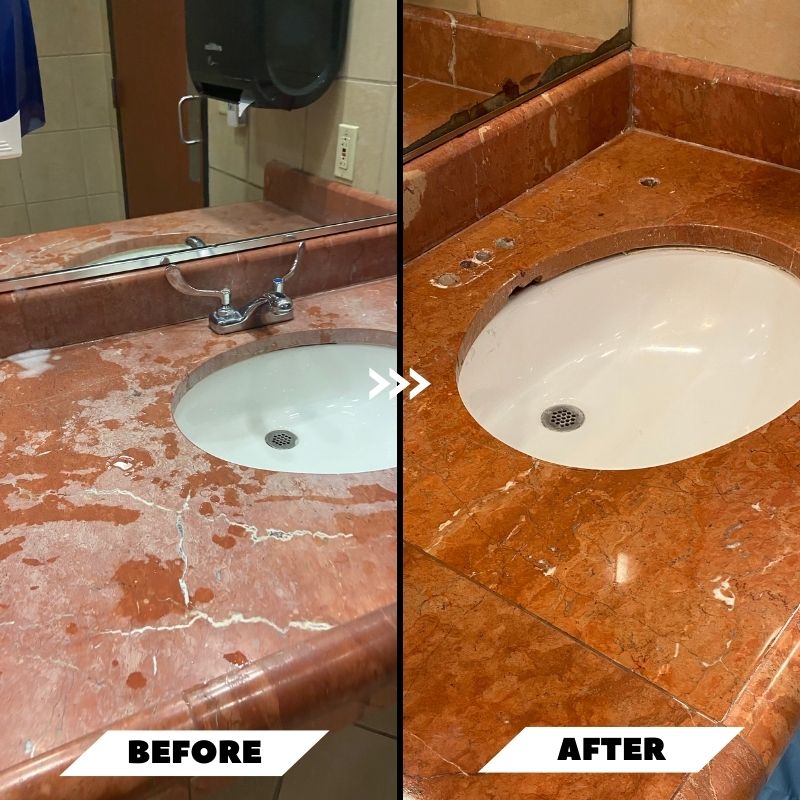
For granite countertops, restoration is often more localized. One section may need chip repair, while the rest of the slab only needs cleaning and sealing. In some cases, granite countertop repair involves color-matched epoxy to rebuild a broken corner or fill a pit. In others, it means correcting a failed seam that has shifted or collected grime. The best result depends on careful color work and patient finishing, not just sticking material into a crack.
The common problems homeowners mistake for “stone damage”
A surprising amount of what people call damage is actually residue. Soap film, hard water minerals, cooking grease, and improperly applied sealer can all leave a countertop looking cloudy or uneven. Before any serious repair begins, the surface needs to be stripped of contamination so you can see the actual condition of the stone.
I once looked at a marble island that the owner thought needed full replacement. The top had broad dull swaths and sticky streaks that caught the light from every angle. She had been using a general-purpose spray for months, then tried a heavy wax product to “bring back the shine.” The stone was etched, yes, but half the ugliness came from layered residue. After proper cleaning, the real repair area shrank by more than half.
That is one reason experienced technicians move slowly in the diagnostic phase. A good granite cleaning company or stone restoration specialist should not rush straight to sanding or polishing. They should test the surface, identify whether the issue is staining, etching, residue, abrasion, impact damage, or failed maintenance, and then recommend the least invasive fix that will hold up.
How marble loses its finish, and how pros bring it back
Marble restoration tends to be more nuanced because the damage is often widespread and the stone is more reactive. On kitchen marble countertops, the usual trouble spots are around the sink, coffee station, prep area, and range. In bathrooms, look for wear around faucets, toiletry storage, and makeup areas.
Etching is the classic marble issue. It appears as lighter, duller marks that feel smooth but interrupt the reflection. The deeper the etch, the more honing is needed. Light etching may be corrected with a polishing powder in skilled hands, but broad or uneven etching usually calls for a full refinishing sequence. This is why spot fixes on marble can be tricky. If you polish one dull ring to a high shine without blending the surrounding field, the repair can stand out even more than the original damage.
Scratches add another layer. Shallow scratches can often be honed out as part of the same process used for etching. Deeper scratches, especially on edges or around undermount sinks, take more care because overworking one zone can create dips or soft spots in the reflection. A polished marble top only looks elegant when it is flat enough to reflect evenly.
Stains are a separate issue. Oil, rust, organic matter, and dyes all behave differently. Marble sealing helps slow stain absorption, but sealers do not stop etching. That distinction is one of the most important things a homeowner can learn. A stone can be perfectly sealed and still etch from acidic contact. If you want more resistance to that kind of surface attack, you may need a specialty treatment such as a more anti etch sealer, though even those products come with limits. They can improve performance, especially in busy kitchens, but they do not make marble bulletproof. They also require proper prep and realistic expectations.
Granite repair is often structural as much as cosmetic
Granite tends to hold up well to daily life, but when it fails, the failure is often obvious. A heavy pot clips an edge and takes out a chip. A weak overhang cracks near a stool. A seam opens slightly and traps dirt, making it look much worse than it is. These are the cases where precise granite countertop repair matters.
Chip repair is one of the most common service calls. A good repair tech can rebuild surprisingly large losses using tinted resins or epoxies, then shape and polish the area so it disappears in normal use. On speckled granite, the repair is often easier to hide because the pattern naturally breaks up the eye. On a solid black polished granite, every detail shows, so the finish work has to be excellent.
Crack repair depends on the cause. If the crack came from impact and the substrate is stable, the repair may hold for years. If the slab cracked because the cabinet support is inadequate or the sink rail is carrying too much load, cosmetic filling alone will not solve it. The same crack will telegraph back or widen again. Structural support has to be corrected first, even if that means detaching plumbing, bracing the area, or reinforcing from below.
Seam work is another specialty. A bad seam can be lippage, separation, discoloration, or all three. Professional seam correction is painstaking because it involves leveling the slabs, cleaning out old material, recoloring as needed, and polishing the affected area without leaving a halo. Homeowners sometimes underestimate this and call any handyman. The result is often a shiny, thick line that catches crumbs and announces itself from across the room.
Cleaning is where most countertop lives are shortened or extended
If I had to name the habit that most often determines whether stone ages well, it would be cleaning discipline. Not obsessive cleaning, just the right cleaning. Natural stone does not need much, but it does punish bad habits over time.
Daily care for both marble countertops and granite countertops should be simple: a pH-neutral stone cleaner or mild soap, a soft cloth, and a dry buff after wiping. Letting water sit around faucets is a slow way to build mineral deposits. Leaving oils near cooktops encourages darkening and residue. Using bathroom disinfectants, bleach sprays, vinegar, or abrasive powders can create problems far bigger than the mess you were trying to remove.
When surfaces already look dull, many people search for a granite cleaning company because they assume the stone is permanently worn out. Sometimes that is true. Often it is not. Deep cleaning by someone who understands stone can remove years of embedded grime, soap film, and sealer buildup. That alone can restore a surprising amount of clarity before any honing or polishing begins.
Sealing matters, but not in the way most people think
Sealer has become the catch-all answer in the stone world, and that has led to a lot of confusion. Sealer is not a gloss enhancer. It is not a scratch shield. It is not a cure for etching. Its main job is to reduce how quickly liquids penetrate the stone.
Marble sealing is important because marble is vulnerable to staining, especially lighter stones in kitchens and baths. Granite also benefits from sealing, though some dense granites absorb very little and need less frequent treatment. The right sealer depends on the stone’s porosity, finish, and use pattern. A honed white marble by a coffee station may need a different strategy than a dark polished granite on a powder room vanity.
The water-drop test can offer a rough clue. If a few drops of water darken the surface within several minutes, the stone may be due for sealing. But this is only a guide. A countertop can resist water well and still be vulnerable to oil-based staining, and some topical or enhanced surfaces require different evaluation.
Homeowners often ask whether they should apply the strongest product available. Not necessarily. Some impregnating sealers are excellent for general stain resistance. Some specialty systems, including more anti etch sealer options, are designed for higher-risk marble installations. Those can be worthwhile for avid cooks who love marble and accept its character, but they require proper installation and maintenance. A bad application can leave haze, unevenness, or unrealistic expectations about acid resistance.
When a DIY fix makes sense, and when it does not
There are a few situations where a careful homeowner can improve a stone top without creating new damage. Cleaning residue, removing light hard water film with stone-safe products, or resealing a countertop that is otherwise in good shape can be reasonable projects. So can addressing a very minor stain with the right poultice, if you know what caused it and test first in an inconspicuous area.
Once you move into etch removal, polishing, chip rebuilding, crack repair, or seam correction, the margin for error narrows fast. Stone restoration tools remove material. If you remove too much, there is no putting it back. The same is true with tinted adhesives. If the color is wrong, or if the repaired area is not shaped and finished correctly, the eye goes straight to it.
A good rule of thumb is this:
- Clean it yourself if the issue is surface grime. Seal it yourself only if the product is clearly appropriate for your stone and finish. Call a pro for etching, deep scratches, chips, cracks, seam issues, or widespread dullness. Stop immediately if a test spot looks worse after your attempt. Get a second opinion before replacing stone that has only cosmetic wear.
That last point matters. People often jump from “this top looks tired” to “we need all new counters.” In many cases, marble restoration or granite countertop repair costs a fraction of replacement, especially when demolition, plumbing disconnects, backsplash risk, and fabrication delays are factored in.
How to judge a restoration company before you hire them
Search results for countertop repair near me can produce a strange mix of specialists, handymen, cleaners, and general contractors. Stone work is its own trade. The right hire has experience with your specific material and your specific problem.
Ask what process they recommend and why. If the answer sounds generic, keep looking. Marble polishing on a polished white island is not the same as restoring a honed black vanity. Repairing a chipped eased edge on granite is not the same as correcting a broken mitered waterfall leg. The details matter.
Photos help, but ask for before-and-after examples that actually resemble your stone. A technician who does excellent travertine floor work may still be weak on high-gloss kitchen marble. Likewise, a company that mainly deep-cleans stone may not be the best choice for structural crack repair. A reputable granite cleaning company should know where their scope ends and when a dedicated repair specialist is needed.
It also pays to discuss finish matching. This is where many repairs succeed or fail visually. A repair can be structurally sound but still disappointing if the gloss level, texture, or edge profile does not match the surrounding slab.
What restoration costs are really buying you
Homeowners tend to focus on the visible action, the polishing pad, the epoxy, the sealer being wiped on. What they are really paying for is judgment. Which abrasive sequence will flatten an etched field without opening the stone too much? How far should a repair be feathered so it blends naturally? Will the slab tolerate a spot repair, or does the whole section need refinishing to avoid a patchy result? Those decisions come from experience.
In practical terms, pricing varies widely by region, stone type, access, and damage severity. A simple chip repair on granite may be modest, while full marble restoration across a large kitchen can be a meaningful project. But replacement is almost always more disruptive. It carries hidden costs, including sink removal, plumbing work, tile or drywall repairs, and the challenge of matching existing finishes.
One client I remember had a large marble island with years of etching, knife scratches, and one ugly dark how to seal marble stain near the prep sink. A showroom had pushed replacement. Restoration took a day and a half, plus stain treatment time, and the top came back with a soft polished finish that suited the house better than the original mirror gloss. The owner kept the character of the stone and avoided a much larger renovation.
Maintenance after restoration is what preserves the result
Once you restore countertops, the next phase is keeping them that way. That means adjusting daily use, not babying the stone to the point of frustration. Marble especially rewards good habits. Wipe spills quickly. Use trivets near hot cookware if temperature shock is a concern. Put trays under oils, vinegars, and toiletries. Dry the area around faucets and soap dispensers. Choose cutting boards instead of treating the countertop like a butcher block.
Here is the short version of a maintenance routine that actually works:
- Use a stone-safe cleaner and a soft microfiber cloth. Reapply sealer on the schedule recommended for your stone and product, not by guesswork. Address chips, cracks, or failing seams early before dirt and moisture enlarge the problem. Avoid acidic or abrasive cleaners, even if the label says “natural.” Schedule professional touch-up polishing or honing before wear becomes severe.
That last point saves money over time. Light periodic service is usually easier and less invasive than waiting until the surface is heavily etched, deeply scratched, or structurally compromised.
Choosing between honed and polished after repair
One of the more interesting decisions during marble restoration is whether to return to polished or switch to honed. Both can be beautiful. Both come with trade-offs.
Polished marble looks rich and bright, especially in spaces with good natural light. It tends to show etching more clearly because the damage interrupts the reflection. Honed marble has a softer, lower-sheen finish that disguises etches better in daily life, though it can show oils more readily on some stones. Families who cook often and want less visual drama sometimes prefer to restore a previously polished top to a honed finish. People who love the crisp, formal look of reflective stone usually stay polished and accept that touch-ups may come sooner.
Granite is a bit different. Most homeowners keep the original finish because it is part of the slab’s character, but leathered and honed granites can also be refreshed when wear appears. The key is matching the finish consistently, especially across repaired areas and seams.
The best restoration is the one you can live with
Perfection is not always the goal, especially with natural stone. Marble develops a patina. Granite may carry a tiny repaired chip that no guest will ever notice. Good restoration respects both the material and the life happening around it. It solves the real problem, improves appearance, and extends service without pretending stone is synthetic and flawless.
If your countertops look tired, stained, dull, chipped, or uneven, do not assume replacement is your only option. Marble polishing, marble sealing, marble restoration, and granite countertop repair are mature trades when handled by people who know stone. The right repair can preserve a kitchen’s best feature, protect your investment, and make the room feel finished again without tearing it apart.
That is what professional restoration does at its best. It does not just make a surface shinier. It brings back clarity, function, and confidence every time you walk into the room.